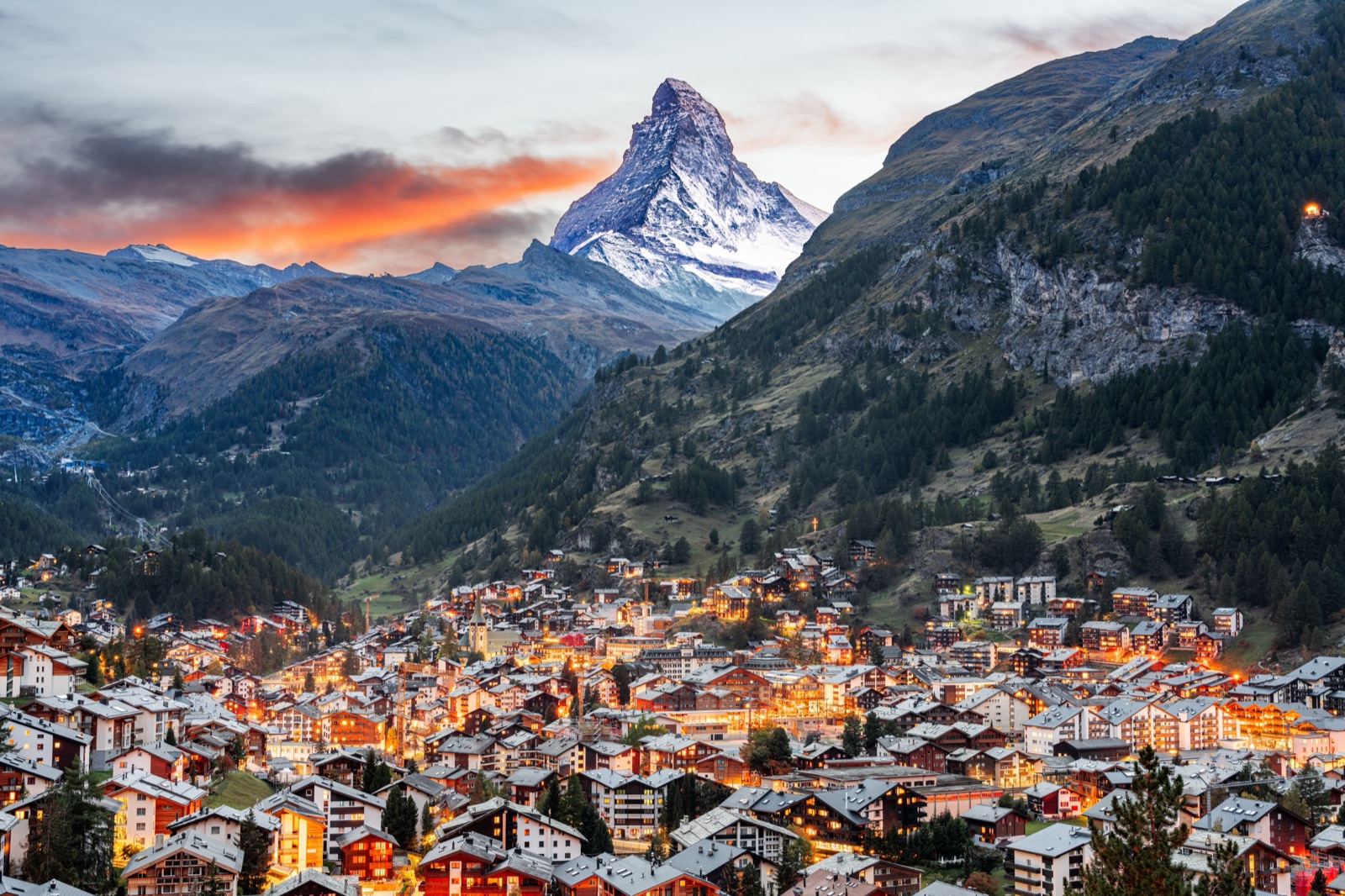
How to Get to Zermatt and the Matterhorn
The Matterhorn is not something you drive up to. It rises above Zermatt, a village at the head of a long valley in the canton of Valais, and Zermatt itself is closed to private cars. Every visit therefore starts with the same question: how do you get to Zermatt, and then from Zermatt up to one of the viewpoints opposite the mountain?
This guide covers the first part — trains, driving to Täsch, the shuttle and getting around the village — and the day trips that do it all for you. The viewpoints themselves are covered in our guide to Gornergrat or Glacier Paradise.
The rule that shapes everything: Zermatt is car-free
Zermatt has no cars. Private vehicles may go only as far as Täsch, the last village down the valley. From there you continue by train, taxi or limousine service.
That single rule decides how you plan:
- If you are coming by train, it makes no difference: the train runs straight into Zermatt.
- If you are driving, you will park in Täsch and take the shuttle train or a taxi for the last stretch.
- Once you are in Zermatt, you walk, or use the village’s own electric transport.
It is also a large part of Zermatt’s appeal. The village is quiet, the air is clean, and the streets belong to pedestrians, electric taxis and the occasional horse-drawn carriage.
By train
The train is the easiest way to Zermatt, and for most visitors it is the obvious one.
- Trains run to Zermatt every half hour.
- From Zurich Airport, the journey takes about three and a half hours.
- From Geneva or Basel airports, about four hours.
- You can also arrive on the Glacier Express, the scenic train that crosses the Alps.
The line runs directly into the centre of car-free Zermatt, so there is no change at Täsch and nothing to organise at the end. With trains every half hour, you can plan loosely and take the next one if you miss a connection.
Tips for the train journey
- Sit on the side facing the valley for the final climb, when the scenery becomes dramatic.
- Keep an eye on connections if you are changing trains on the way; the half-hourly service to Zermatt makes missed connections an inconvenience rather than a disaster.
- Travel light if you can. Zermatt’s streets are walkable but some hotels are uphill; a rolling suitcase on cobbles is hard work.
By car: driving to Täsch
If you are driving, your journey ends in Täsch. The Täsch terminal is built for exactly this: you park and switch to the shuttle.
The shuttle train
- Shuttle trains run every 20 minutes.
- The journey takes 12 minutes.
- You board directly from the terminal.
- The final stop is right in the centre of Zermatt.
The alternative is a taxi from Täsch to Zermatt, which is useful late in the evening or with a lot of luggage.
Why drivers still enjoy it
It sounds like a complication, but in practice the shuttle is simple: park, walk into the terminal, board a train that leaves every twenty minutes, and step out in the village twelve minutes later. There is no hunting for parking in Zermatt, because there is none.
Getting around Zermatt
Once you are in the village, you have several options, and none of them involves a car:
- On foot. Zermatt is compact, and the main sights and lift stations are within walking distance of the station.
- The free e-bus, with two routes: the Ski-Bus and the Winkelmatten line.
- E-taxis, for luggage or tired legs.
- Horse-drawn carriages, the traditional option.
- Bicycles and mountain bikes.
The practical point for a Matterhorn visit is that the Gornergrat railway’s valley station is directly opposite Zermatt station. If you arrive by train and head straight up, you barely need to walk at all.
From the village to the viewpoints
Nobody sells the Matterhorn itself — what you buy is a ride up opposite it. From Zermatt, three lifts lead to three very different viewpoints:
- The Gornergrat railway, a cogwheel line from 1,604 m in the centre of Zermatt to 3,089 m, opened in 1898. Its summit station is Europe’s highest open-air railway station.
- The cable car to Matterhorn Glacier Paradise at 3,883 m, the highest mountain station in Europe, with a platform looking out over 38 four-thousand-metre peaks and 14 glaciers in three countries.
- The Sunnegga funicular, the shortest ride of the three, to a lower viewpoint above the village.
Our guide to Gornergrat or Glacier Paradise compares them in detail, including fares and timetables.
Day trips from Geneva and Lausanne
If you are based at Lake Geneva and do not want to organise the journey yourself, guided day trips do it for you.
From Geneva
The Zermatt day trip from Geneva takes about 13 hours. You travel along Lake Geneva to Täsch, take the electric shuttle into car-free Zermatt, and have free time in the old village beneath the Matterhorn. Return transport from Geneva is included.
From Lausanne
The Zermatt day tour from Lausanne follows the same route and takes about 11.5 hours. It offers the Glacier Paradise cable car as an option, and on a clear day the views take in the Swiss, French and Italian Alps.
Are the day trips worth it?
They are long days, and a large part of each is spent travelling. Compare the time you actually have in Zermatt with the total length of the tour, not only the price. If you want to ride up to a viewpoint, check whether there is time for it, or whether the lift is included as an option.
For visitors with only one free day at Lake Geneva, a guided day trip is the simplest way to see the Matterhorn. For anyone with more time, a night or two in Zermatt gives you the chance to see the mountain at dawn and dusk and to choose the clearest day for the lifts.
What a Matterhorn day costs
The journey to Zermatt is only part of the budget. The ride up to a viewpoint is the other, and it is worth knowing the numbers before you go.
The Gornergrat railway publishes its fares from Zermatt for May 2025 to October 2026:
| From Zermatt to | One way | Return |
|---|---|---|
| Gornergrat | CHF 66 | CHF 132 |
| Rotenboden | CHF 57 | CHF 114 |
| Riffelberg | CHF 42 | CHF 84 |
| Riffelalp | CHF 29 | CHF 58 |
Two practical points follow from that table:
- You do not have to go to the top. The intermediate stops are cheaper and still have the Matterhorn in view. One option is to ride up to the summit, then walk part of the way down and pick up the train at a lower stop.
- A one-way ticket plus a walk down is a good option on a fine day, if you are comfortable on mountain paths.
If you are coming on a guided day trip from Geneva or Lausanne, check what the price includes: the Lausanne tour offers Glacier Paradise as an option, so the lift is an extra rather than part of the base price.
The mountain you are looking at
It helps to know a little about the Matterhorn before you stand opposite it.
- Height: the Matterhorn is 4,478 m high.
- First ascent: it was first climbed on 14 July 1865 by a roped party of seven that included Edward Whymper and Peter Taugwalder senior and junior, by the Hörnli ridge. That is still the standard Swiss route today; the standard Italian route follows the Lion ridge on the other side.
- The Solvay Hut, an emergency bivouac, stands at 4,003 metres on the Hörnli ridge.
From Zermatt and the viewpoints above it, the Hörnli ridge is the line you see running up the mountain’s north-east side towards the summit. Knowing that it is the route of the first ascent — and of most climbers today — makes the view far more than a postcard.
You do not need to climb the Matterhorn to enjoy it, of course. The viewpoints opposite, at 3,089 m on the Gornergrat and 3,883 m at Glacier Paradise, bring you close enough to see the shape of its faces and ridges in detail.
Arriving in winter or summer
Zermatt is a year-round resort, and the season changes what you do when you arrive.
In winter, Zermatt is a ski village. The Gornergrat sits at the heart of the Zermatt ski area, and many of the people on the trains and lifts are skiers. Sightseers are welcome on the same lifts, but expect ski boots and equipment around you, and dress for cold at altitude.
In summer, the lifts carry hikers and sightseers, and the walks between the Gornergrat’s intermediate stops are at their best. Glacier Paradise keeps its glacier skiing going well into the warm months: summer skiing there runs from 4 May to 31 October 2026.
Around the changeover, check timetables carefully. The Gornergrat railway’s main summer timetable runs from 20 April to 1 November 2026, and the line is closed from 2 to 14 November 2026 for construction work.
Staying in Zermatt versus visiting for the day
A day visit works if you arrive early, go straight up to one viewpoint and accept that the weather on that one day decides what you see.
A stay of one or two nights changes the experience:
- You can go up on the clearest morning, rather than on the day your train happens to arrive.
- You can see the Matterhorn at sunrise and sunset, when the light on the peak is at its most dramatic.
- You can visit two viewpoints — Gornergrat one day, Glacier Paradise the next — without rushing.
- You get the village after the day visitors leave, which is when it is at its quietest.
The Matterhorn is often hidden by cloud. The more time you give it, the better your chances of seeing it clearly.
With luggage, children or limited mobility
Car-free Zermatt is easier to manage than it sounds, even if you are not travelling light.
- The train takes you all the way in. There is no change at Täsch if you arrive by rail, and the station is in the centre of the village.
- If you drive, the shuttle is built for luggage. You board directly from the terminal at Täsch, and the final stop is right in the centre of Zermatt.
- E-taxis meet the problem of heavy bags and uphill hotels. Ask your hotel whether it offers a pick-up from the station.
- The free e-bus covers the two main routes through the village.
- The Gornergrat valley station is directly opposite Zermatt station, so the most famous viewpoint involves almost no walking from the train.
For visitors with reduced mobility, the lifts themselves do the climbing: the Gornergrat railway and the cable car to Glacier Paradise both take you to their viewpoints without any walking beyond the stations. At the top, it is the altitude and the cold that need planning for, not the terrain around the platforms.
Families should plan around the long journey days. Four hours from Geneva or Basel airports is manageable with children; a 13-hour day trip from Geneva is a much bigger ask, and a night in Zermatt usually makes for a happier visit.
A sample arrival day
- Morning: train to Zermatt, arriving in the centre. Leave bags at your hotel or in a locker.
- Late morning: if the sky is clear, cross to the Gornergrat valley station opposite and go straight up.
- Afternoon: walk back to the village, explore the old quarter, and check the forecast for tomorrow.
- Evening: watch the last light on the Matterhorn from the village.
- Next morning: if it is clear, take the cable car to Glacier Paradise.
If you are driving, add the shuttle from Täsch at the start and the end: park, board, and twelve minutes later you are in the centre.
Practical tips
- Check the Gornergrat timetable for your date. From 20 April to 1 November 2026, trains run every 24 minutes from 08:00, with the first train at 07:00. The line is out of service from 2 to 14 November 2026 for construction work, with no alternative transport.
- Pack for the mountain, not the valley. Even on a warm day in Zermatt, the viewpoints at 3,089 m and 3,883 m are far colder and windier.
- Watch the clouds, not the calendar. A clear morning is worth rearranging your plans for.
- Consider a rail pass. If you are travelling around Switzerland by train, compare the cost of your journey to Zermatt with a pass before buying individual tickets.
Frequently asked questions
Can you drive to Zermatt?
No. Zermatt has no cars; private vehicles may go only as far as Täsch. From Täsch, shuttle trains run every 20 minutes and take 12 minutes to the centre of Zermatt, or you can take a taxi.
How long is the train to Zermatt from Zurich?
About three and a half hours from Zurich Airport, and about four hours from Geneva or Basel airports. Trains run to Zermatt every half hour.
How do you get around Zermatt?
On foot, by the free e-bus (the Ski-Bus and Winkelmatten routes), by e-taxi, horse-drawn carriage or bicycle.
Can I see the Matterhorn on a day trip from Geneva?
Yes. The day trip from Geneva takes about 13 hours, with free time in Zermatt; the tour from Lausanne takes about 11.5 hours and offers the Glacier Paradise cable car as an option.
Where does the Gornergrat railway start?
Directly opposite Zermatt railway station, at 1,604 m in the centre of the village.
Is it worth staying overnight in Zermatt?
If you can, yes. The Matterhorn is often hidden by cloud, and staying gives you more than one chance to see it clearly, plus sunrise and sunset on the peak.
How much does the Gornergrat railway cost?
From May 2025 to October 2026, a return from Zermatt to Gornergrat is CHF 132 (CHF 66 one way). The intermediate stops are cheaper: Rotenboden CHF 114 return, Riffelberg CHF 84 and Riffelalp CHF 58 — all with the Matterhorn in view.
Can I ski in summer at Zermatt?
Yes. Summer skiing at Matterhorn Glacier Paradise runs from 4 May to 31 October 2026.