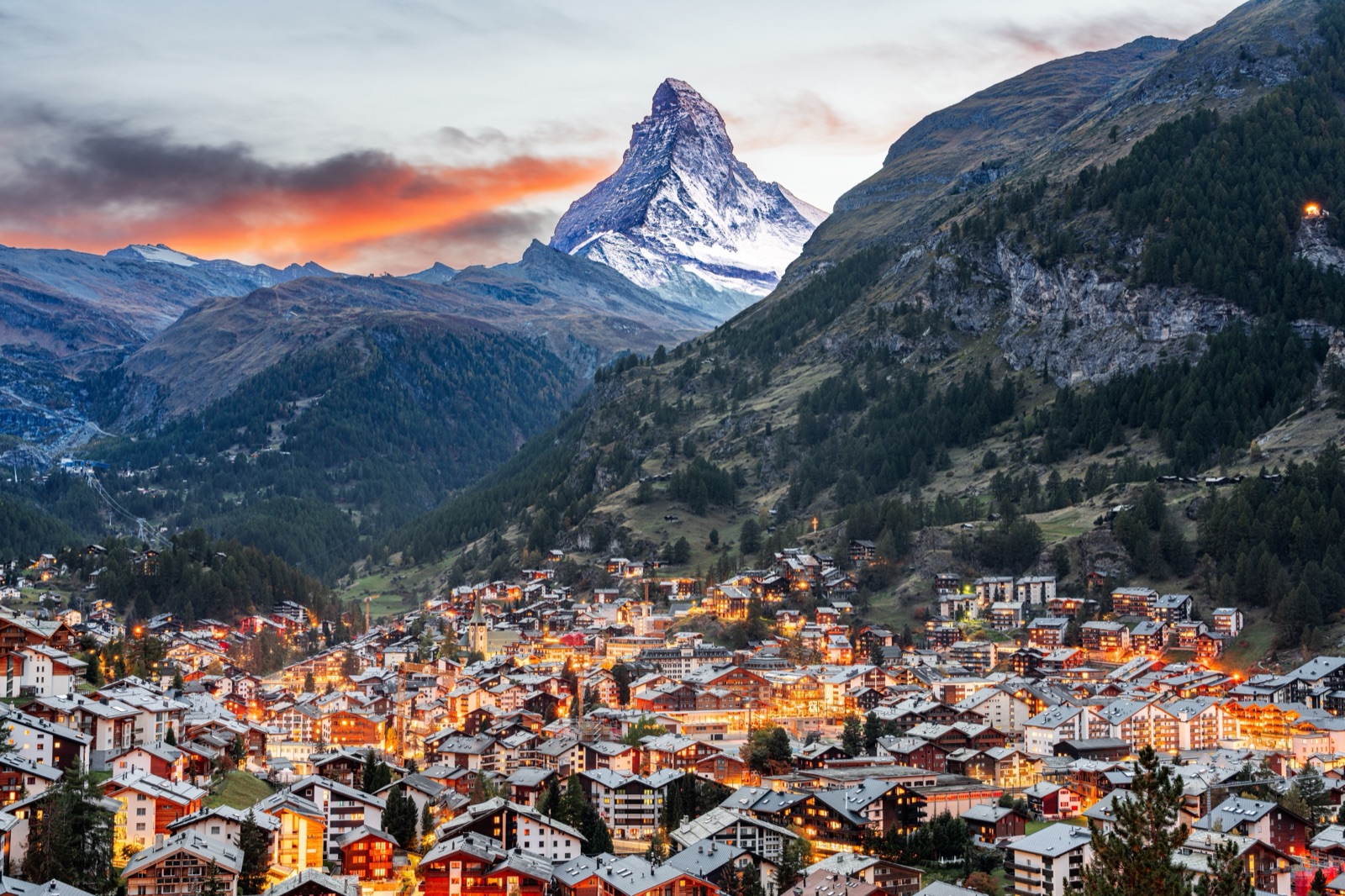
Where to Stay for the Matterhorn: Zermatt, Täsch, Randa or Cervinia
For most visitors the best place to stay for the Matterhorn is Zermatt itself: the lifts start in the village, you can be on the first train of the morning when the mountain is most often clear, and you can see the Matterhorn from the streets. Zermatt has well over 100 hotels and many chalets and holiday flats. If you are driving or watching the budget, the two villages down the valley are the alternatives: Täsch, about five kilometres away, where the car parks and the shuttle train are, and Randa, 9 km from Zermatt, quieter and with reasonably priced accommodation. On the Italian side, Breuil-Cervinia sits at the foot of the Matterhorn’s south face. This guide compares them and explains where in Zermatt to look.
The short answer
| Base | Best for | Getting to the lifts |
|---|---|---|
| Zermatt | First-time visitors, sunrise, skiing, families | On foot or by e-bus |
| Täsch | Drivers, budget, late arrivals | Shuttle train, 12 minutes |
| Randa | Quiet, budget, the suspension bridge | Local train to Zermatt |
| Breuil-Cervinia | Italian-side skiing, Aosta Valley trips | Cable car over the border |
| On the mountain | Sunrise and sunset at altitude | You are already there |
If you only have one or two nights and want the best chance of a clear Matterhorn, stay in Zermatt and take an early lift. Our guide When to See the Matterhorn explains why mornings matter and how many days to allow.
Staying in Zermatt
Zermatt has been car-free since 1961, and that shapes everything about staying there. You arrive by train, or by the shuttle train from Täsch, and get around on foot, by e-taxi, horse-drawn carriage, bicycle or the free e-bus, which runs two routes: the Ski-Bus and the Winkelmatten line. The village has no large hotel blocks and no flat roofs, and its main street, the Bahnhofstrasse, is a promenade of shops, bars, bakeries and restaurants.
The advantages of sleeping in the village are practical:
- Early starts. The Gornergrat railway’s first train leaves Zermatt at 07:00 in the summer timetable, and the cloud usually builds as the day goes on.
- Evening light. You can watch the last light on the Matterhorn from the church bridge, where the mountain rises alone to the south-west, and wake up for the sunrise on its east face.
- No transfers. Every lift is a walk or a short e-bus ride away.
- Children stay free. With the Wolli Card, children up to the age of nine stay free in the parents’ room in registered hotels, and in a cot or extra bed in registered holiday flats.
The drawback is price. Zermatt is a famous resort with high demand, and rooms with a Matterhorn view cost more.
Where in Zermatt to stay
Zermatt is long and narrow, strung out along the river, so which end you stay at makes a difference.
Near the station and Bahnhofstrasse. The most convenient base for arriving and leaving with luggage, and the Gornergrat railway’s valley station is directly opposite the main railway station. Good for a short stay built around the Gornergrat.
Near the Sunnegga funicular. The valley station is close to the centre on the river. Staying near it makes sense for families heading to the Leisee and for skiers who favour the Sunnegga–Rothorn side.
The old village (Hinterdorf) and around the church. Around 30 old Walser buildings, some up to 500 years old, and the church square with its view of the Matterhorn. Atmospheric and central, with the historic hotels close by: the Hotel Monte Rosa was the first hotel in Zermatt, and Edward’s Bar there keeps beams and walls from the village’s first inn of 1839.
Towards the Matterhorn Express. The gondola to Furi, Schwarzsee, Trockener Steg and Matterhorn Glacier Paradise leaves from the southern end of the village. A base at this end suits skiers on the glacier side and hikers heading for the Glacier Trail or the Hörnli hut. The Gorner gorge is a 15-minute walk from the southern end of the village.
Winkelmatten. A quieter district above the river, served by the Winkelmatten e-bus and close to the end of the Findlerweg. Further from the shops, but often with open views.
When you book, ask whether the room faces the Matterhorn, how far the hotel is from the lift you plan to use, and whether the hotel collects luggage from the station.
Staying in Täsch
Täsch is the gateway to Zermatt. It is a village of 1,200 inhabitants, about five kilometres down the valley at 1,449 m, on a flat valley floor. Private cars can go only as far as Täsch, so drivers leave their cars there and take the shuttle train, which runs every 20 minutes, takes 12 minutes and stops right in the centre of Zermatt.
Reasons to stay in Täsch:
- You are driving. You can park, sleep and take the shuttle in the morning without moving the car.
- Budget. Accommodation in the smaller villages is generally cheaper than in Zermatt itself.
- Cross-country skiing and golf. In winter Täsch is the region’s cross-country skiing centre, with 15 km of groomed trails, and in summer it has a 9+-hole golf course.
The cost is the daily commute. With a Peak Pass, the Matterhorn Gotthard Bahn between Randa, Täsch and Zermatt is included, which removes the cost of the shuttle on lift days.
Staying in Randa
Randa is the quiet choice. The village has 500 inhabitants, lies 9 km from Zermatt below the great pyramid of the Weisshorn, and Zermatt Tourism promises reasonably priced accommodation with a cosy, traditional feel. It is the base for climbers heading for the Dom and Täschhorn, and the start of the circular walk to the Charles Kuonen suspension bridge, at 494 m the longest pedestrian suspension bridge in the Alps.
Randa is on the railway line to Zermatt, and its multi-storey car park by the station is cheap by Swiss standards: CHF 1 per hour or CHF 12 per day, with 88 covered spaces and 12 more by the church. The Peak Pass covers the train from Randa as well. The trade-off is a longer journey each morning and fewer restaurants in the evening.
Parking for drivers
If you drive, you will park in Täsch or Randa. Zermatt Tourism lists 12 car parks and parking services there.
| Car park | What to know |
|---|---|
| Matterhorn Terminal, Täsch | 2,100 covered spaces under the same roof as the shuttle station; luggage trolleys go on the train |
| Cervin Park, Täsch | One minute on foot from the station, from CHF 8 |
| Randa car park | 88 covered spaces plus 12 by the church; CHF 1 per hour, CHF 12 per day |
| Taxi and parking packages | Täsch operators combine a parking space with an e-taxi transfer to Zermatt |
Our guide How to Get to Zermatt covers the drive, the shuttle and the train connections in detail.
Hotel, chalet or holiday flat?
Zermatt’s accommodation runs from simple guesthouses to grand historic hotels, with a large stock of chalets and holiday flats in between. Which suits you depends on how long you stay and who you travel with.
- Hotels make most sense for short stays. Breakfast is included, staff can advise on lifts and weather, and the historic hotels in the centre, such as the Monte Rosa, the Grand Hotel Zermatterhof and the Mont Cervin Palace, have bars open to non-residents if you want the atmosphere without the bill.
- Holiday flats and chalets suit families and longer stays. A kitchen saves money in an expensive resort, and a picnic on the trail is part of the fun anyway.
- Mountain huts and hotels above the village suit one special night rather than a whole holiday.
Families should check whether the place is registered for the Wolli Card, because that decides whether children up to the age of nine stay free.
Arriving with luggage
Car-free Zermatt is easy with luggage if you plan it. At the Matterhorn Terminal in Täsch, luggage trolleys can go with you onto the shuttle train, which stops right in the centre of Zermatt. In the village, e-taxis and the free e-bus cover the main routes. If your hotel is at the far end of the village or up a slope, ask before you arrive how best to reach it with cases.
Travelling on to Italy? Since 1 November 2025 you can send luggage between Zermatt and Cervinia by cable car, so you can cross the border on the Matterhorn Alpine Crossing with only a day pack.
What a stay costs beyond the room
The room is only part of the bill. Budget for:
- Visitor’s tax, charged by the destination; children with the Wolli Card are exempt.
- Lift tickets. A Gornergrat return was CHF 132 in the May 2025 to October 2026 period, and the Peak Pass for several lifts costs from CHF 190. Holders of the half-fare card, GA or Swiss Travel Pass get 50% off the Gornergrat railway and 25% off the Peak Pass.
- Parking, if you drive: from CHF 8 at Cervin Park in Täsch, or CHF 12 a day in Randa.
- Food. Mountain restaurants are part of the experience, but a kitchen or picnics keep costs down.
Staying in Breuil-Cervinia
Breuil-Cervinia is the modern resort on the Italian side, at 2,000 metres in a wide hollow at the top of the Valtournenche valley. It has 700 inhabitants and lies 52 km from Aosta. The Matterhorn, here called Monte Cervino or the Gran Becca, rises right above it.
Stay in Cervinia if you are skiing the Italian side, combining the Matterhorn with the Aosta Valley, or arriving from Milan or Turin: the resort’s lift company gives Milan Malpensa as 2h 16’ and Turin as 1h 42’ away. The link to Zermatt is the Matterhorn Alpine Crossing, the cable car route that takes 90 minutes and crosses the border at nearly 3,500 metres. Since 1 November 2025 luggage can travel separately between the two valley stations: check it in by 10am or 2pm and collect it two hours later, from 12pm or 4pm, at the other end.
The catch is that the classic Matterhorn view, the pyramid of the north and east faces, is the Swiss one. From Cervinia you see the south face. Our journal article on Cervinia covers the resort in depth.
Staying on the mountain
A few places let you sleep high above the village, and they are memorable for sunrise and sunset when the day visitors have gone. Hotels and mountain restaurants along the Gornergrat line and in the hamlets above Zermatt are worth looking at if you want the mountain to yourself in the evening.
The extreme option is the Hörnli hut at 3,260 m, at the foot of the Matterhorn’s climbing ridge. It has accommodation for 150 guests and a restaurant for 130, and is open only in summer, from the end of June until the end of September. An overnight stay with half board costs from about CHF 150 per person. It is reached on foot from Schwarzsee in about 2 hours on a demanding T4 path, and most guests are climbers starting for the summit; see Climbing the Matterhorn.
A day trip instead of an overnight stay
If your base is Geneva or Lausanne and you cannot stay over, a guided day trip is the simplest option. From Geneva, the trip runs by road along Lake Geneva to Täsch, takes the electric shuttle into car-free Zermatt and gives you free time in the old village; it takes about 13 hours. From Lausanne the day tour takes about 11.5 hours, with the Glacier Paradise cable car available as an option. Both are on our tours page.
The honest trade-off: a day trip gets you to Zermatt in the middle of the day, when the Matterhorn is most likely to be in cloud. Staying at least one night gives you an evening and a morning, which are the best chances to see it.
When to book
Zermatt is busy in the main winter weeks and in high summer, and the best-located rooms go early. A few dates are worth knowing when you plan:
- Winter 2026/27 runs from 1 November 2026 to 3 May 2027; Sunnegga/Rothorn and Gornergrat open on 28 November 2026.
- The lowest winter lift prices apply from 1 to 27 November 2026 and from 19 April to 2 May 2027, which are also quieter weeks in the village.
- The Gornergrat railway was out of service from 2 to 14 November 2026 for construction work.
- The Hörnli hut opens only from the end of June to the end of September.
Outside the main seasons, check that the lifts you want are running before you book. For the weather by month, see the Zermatt weather page.
How to choose
- First visit, one or two nights: Zermatt, near the station or the Gornergrat railway.
- Family with young children: Zermatt, in a Wolli Card hotel or flat, near the Sunnegga funicular.
- Ski week: Zermatt near the lift you will use most, or Cervinia for the Italian slopes.
- Driving, on a budget: Täsch, with the shuttle train in the morning.
- Quiet and cheaper: Randa, with the Peak Pass covering the train.
- Sunrise above the clouds: a mountain hotel along the Gornergrat line.
- Climbers: the Hörnli hut, with a guide.
Travelling with children? Our guide Zermatt with Kids has the Wolli Card details and the lift discounts.
Frequently asked questions
Is it better to stay in Zermatt or Täsch?
Stay in Zermatt if you want early lifts, evening views and no daily commute. Stay in Täsch if you are driving or on a tighter budget; the shuttle train to Zermatt runs every 20 minutes and takes 12 minutes.
Can you see the Matterhorn from Zermatt village?
Yes, in clear weather. One of the classic views is from the church steps of St Mauritius or the church bridge, looking south-west.
How far is Randa from Zermatt?
Randa lies 9 km from Zermatt, on the railway line, and is a quieter, cheaper base with parking at CHF 12 per day.
Can you stay on the Matterhorn?
The Hörnli hut at 3,260 m, at the foot of the climbing route, has accommodation for 150 guests from the end of June to the end of September. Most guests are climbers.
How many nights should I stay in Zermatt?
At least one night, so you have an evening and an early morning; two or three nights give you a real chance of a clear day if the first one is cloudy.