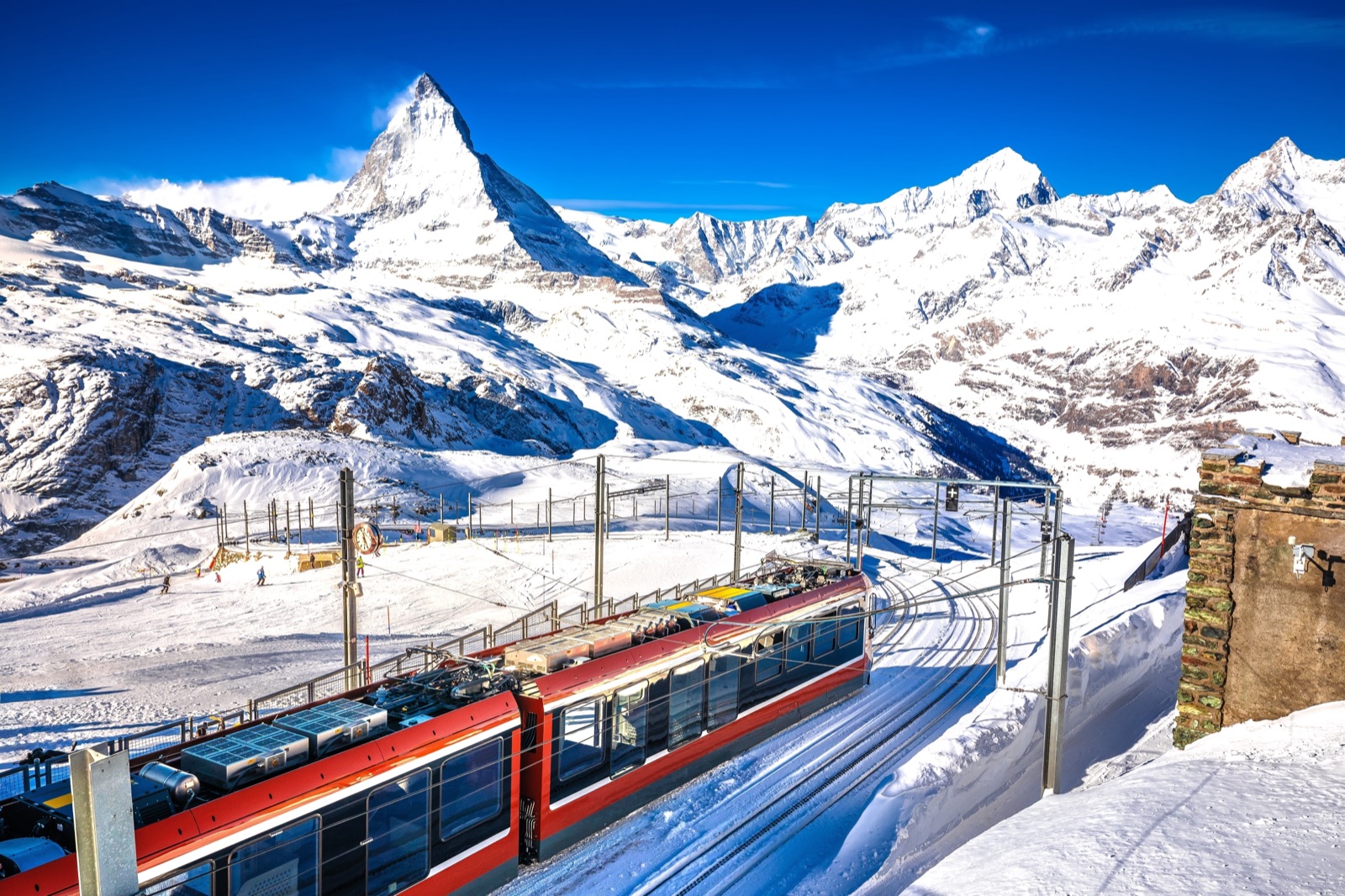
Skiing at the Matterhorn: Zermatt Ski Areas, Lift Passes and Cervinia
Skiing at the Matterhorn means skiing at Zermatt, in what the lift company sells as the Matterhorn Ski Paradise: 360 km of pistes and 52 lifts across 2 countries, linked over the border to Breuil-Cervinia in Italy, and topping out at Matterhorn Glacier Paradise at 3,883 m, which makes it the highest ski area in the Alps. The Swiss side alone has around 200 km of slopes. The 2026/27 winter season runs from 1 November 2026 to 3 May 2027, a winter day pass costs from CHF 89 (or from CHF 104 including Cervinia), children up to 8.99 ski free, and on the glacier you can ski in summer too. This guide explains how the area fits together, what the passes cost and how to plan your days.
The ski area in one paragraph
Zermatt’s ski area is four areas joined by lifts and runs. Sunnegga–Blauherd–Rothorn is the sunny side, reached by the funicular from the village. Gornergrat is reached by the cogwheel railway and has long, scenic blue and red runs. Matterhorn Glacier Paradise is the high-alpine glacier area above Trockener Steg, open for skiing all year. Cervinia–Valtournenche is the Italian side, over the Theodul Pass, with its own long runs. With the right pass, you can ski from Zermatt into Italy and back in a day.
| Area | Character | Access from Zermatt |
|---|---|---|
| Sunnegga – Blauherd – Rothorn | Sunny pistes, beginner area, big views | Sunnegga funicular |
| Gornergrat | Panoramic blues and reds | Gornergrat railway |
| Matterhorn Glacier Paradise | Glacier skiing up to 3,883 m | Matterhorn Express gondola |
| Cervinia – Valtournenche | Italian side, cruising runs | Via Trockener Steg and the Theodul Pass |
Season dates for 2026/27
According to Zermatt Bergbahnen, the 2026/27 winter season starts on 1 November 2026 and ends on 3 May 2027. Not everything opens at once:
- Matterhorn Glacier Paradise is open from the start, because it is glacier skiing.
- Sunnegga/Rothorn and Gornergrat open on 28 November 2026.
- Sunnegga/Rothorn closes on 11 April 2027 and Gornergrat on 18 April 2027.
So early November and late April are glacier-only, which is also when the lowest winter pass prices apply: from 1 to 27 November 2026 and from 19 April to 2 May 2027. The Gornergrat railway itself was out of service from 2 to 14 November 2026 for construction work. For snow and weather month by month, see When to See the Matterhorn and the Zermatt weather page.
Winter lift pass prices
Zermatt Bergbahnen prices passes dynamically: the figures below are the “from” prices for winter 2026/27, and you pay more on busy dates. There are two main passes: Zermatt (Swiss side only) and International (Zermatt plus Cervinia and Valtournenche).
| Days | Zermatt pass | International pass |
|---|---|---|
| Half day (from 12.15 h) | from CHF 68 | not available |
| 1 day | from CHF 89 | from CHF 104 |
| 3 days | from CHF 209 | from CHF 232 |
| 6 days | from CHF 384 | from CHF 432 |
Useful details:
- The half-day pass is valid for the Zermatt ski area only, not Cervinia.
- Flex passes let you pick your days within a window, for example 2 in 4 days from CHF 176 (Zermatt) or CHF 197 (International). They are good insurance against bad weather.
- Extensions: passes valid for at least 5 days can be extended once at the end of their validity.
- One Italian day: if you hold a Zermatt pass and want a single day in Italy, an extra Cervinia/Valtournenche day ticket costs CHF 52.
- The Glacier Palace costs CHF 10 for adults and CHF 5 for children with a ski pass.
Buying online in advance is usually cheaper than on the day, and it means no queue at the ticket desk. Tickets can be loaded onto a KeyCard or used as a smartphone ticket; if you collect a ticket without a card, a CHF 5 deposit per ticket is charged and refunded when you return it.
Discounts for children and young people
Zermatt is generous with children on the slopes:
- Up to 8.99 years: the ski pass is free (a pass with a photo is required).
- 9 to 15.99 years: 50% off.
- 16 to 19.99 years: 15% off.
- Saturdays: the Zermatt ski pass is free for children up to 15.99.
The reduction depends on the date of birth, so carry an ID document showing it. Non-skiing children up to the age of nine can also get the free Wolli Card, which covers lifts all year; it is explained in our guide to Zermatt with kids.
Learning to ski: the beginner area
Zermatt Tourism is clear that beginners are welcome, and the set-up proves it. The Beginner ski pass covers Zermatt–Sunnegga, Sunnegga–Blauherd, the Eisfluh lift, the Findel chairlift and the Leisee shuttle, from CHF 60 for 1 day or CHF 160 for 3 days. That is all a new skier needs for the first days.
At the heart of it is the Wolli beginners’ park on Sunnegga, a sunny, wind-protected area with five magic carpets and play equipment, reached by the self-service Leisee shuttle from the top of the funicular. Zermatt Tourism listed 17 ski and snowboard schools in November 2026, offering group and private lessons for children and adults, and rental shops in the village hire skis, boards and boots.
Once the first turns are solid, the natural next step is the blue runs around the Gornergrat and Riffelberg, which the new Ski Safari routes (below) are designed around.
The Matterhorn Ski Safari routes
New for winter 2026/27, Zermatt Tourism has mapped seven Matterhorn Ski Safari routes in three levels, so you can plan a day by ability rather than by piste map:
- First Ski Experience (blue): about 5 h 16 min, 8 km of runs and 8 lifts, from Wolli’s Beginners’ Park via Eisfluh and Findeln to Blauherd, on the Beginner ski pass.
- Beyond First Turns (blue): about 4 h, 10 km of runs and 8 lifts around the Gornergrat and Riffelberg.
- Scenic Sun Hunter (red): about 3 h 45 min, 40 km of runs in the Sunnegga–Rothorn area, with photo spots and mountain restaurants.
- Classic Panorama Cruiser (red): about 4 h 25 min, 34 km of runs from the Gornergrat via Gant and Hohtälli.
- Swiss-Italian Flirt (red): 73 km of runs and 13 lifts, via Trockener Steg and the Theodul Pass to Cervinia and back via Furggsattel.
- Vertical Mission 10k (black): about 6 h 40 min, 102 km of runs and 23 lifts.
- Vertical Mission 12k (black): 135 km of runs and 29 lifts, all the way to Valtournenche.
The Beginner ski pass is enough for First Ski Experience; Swiss-Italian Flirt and both Vertical Missions need the International pass. The two Vertical Missions are full days that need an early start and excellent stamina.
The runs with the best Matterhorn views
Every area faces the mountain, but the lift company singles out a few pistes: Rothorn–Sunnegga (pistes 11 and 7), Tufternkumme (piste 15) and the Hirli area (pistes 52 and 54), the last right under the Matterhorn’s east face. From the Rothorn, runs drop more than 1,400 metres in height, which makes a long morning on their own.
The Gornergrat side is the classic panorama: the railway was built for the view, and in winter it is at the heart of the ski area. If you want the summit platform and its 29 four-thousanders without skiing all day, our guide to Gornergrat or Glacier Paradise compares the two big viewpoints.
Skiing into Italy
The link to Cervinia is one of the reasons to ski here. With the International pass you ride from Zermatt to Trockener Steg, cross the Theodul Pass at the border and ski down into the Italian resort. Breuil-Cervinia has 150 km of slopes of its own, and, linked with Zermatt and Valtournenche, a total of 360 km of runs.
Three things to remember on the Italian side:
- Helmets are compulsory on the Italian slopes.
- Check the last lift back. The return to Switzerland depends on the lifts over the border, and missing it means a long and expensive trip round by road.
- Wind closes the link. Zermatt Bergbahnen’s terms say weather, in particular strong winds, avalanche risk or heavy snowfall, can make the Cervinia area unreachable from Zermatt.
For the resort itself, the Matterhorn Alpine Crossing cable car and the summer link, read our journal article on Cervinia.
Summer skiing on the glacier
Zermatt Bergbahnen offers skiing and snowboarding 365 days a year. In summer, the glacier ski area at Matterhorn Glacier Paradise stays open: summer skiing runs from 4 May to 31 October 2026, and on the Italian side the Plateau Rosà and Ventina glaciers offer about 25 km of slopes linked to Switzerland.
Summer ski passes in 2026 cost CHF 99 for one day for adults, CHF 84 for youths and CHF 50 for children, with a lower rate (CHF 84 for adults) between 23 May and 26 June. If you already have a Peak Pass for sightseeing, you can add the glacier ski area for CHF 40 a day (CHF 20 for children) between 1 May and 31 October.
Summer skiing is best done early. The glacier snow is firm in the morning and softens quickly in the sun, and the views of the Matterhorn are usually clearest before the midday cloud builds.
Lunch on the slopes and special experiences
Mountain restaurants are part of the Zermatt ski day, and many of them face the Matterhorn. The tourism office’s Ski Safari notes point to Findeln, below Sunnegga, as a great place for a break, with many mountain restaurants close together; the Beyond First Turns route also passes the Iglu-Dorf igloo village near the Gornergrat. On busy days it is worth booking a table, and eating a little earlier or later than the midday rush.
Zermatt Bergbahnen also sells a handful of experiences that are hard to find elsewhere:
- First Track: ride up before the lifts open to the public, ski the freshly prepared slopes as the sun rises, then have breakfast in a mountain restaurant.
- Piste preparation: join the crews at night as they groom the runs for the next day.
- Moonlight Descent: ski by night in the light of the moon, rounded off with a fondue.
- Ski test: at the test centre on Trockener Steg you can try current skis with expert advice.
These are bookable on the lift company’s web shop and run on set dates through the winter, so check availability before you travel.
Altitude and safety
The top of the ski area is at 3,883 m, and the air up there is thin. Children under three are not allowed on the sections from Trockener Steg to Matterhorn Glacier Paradise and on to Testa Grigia, for health reasons (altitude sickness). Adults should take the first day gently too.
The lift company asks every skier to watch the snow report and the avalanche danger levels, and to go off-piste only with a mountain guide. Freeriding, heliskiing with Air Zermatt and ski touring are all possible here, but they are for experienced people with the right equipment and local knowledge. Keep the emergency numbers in your phone: Mountain Rescue is +41 27 966 01 44, and KWRO/Air Zermatt is 144.
If an experience you booked with Zermatt Bergbahnen is cancelled for bad weather, the amount paid is credited back automatically to the payment method used.
Beyond the pistes
Not everyone in the group will ski every day. Zermatt in winter also has:
- Winter walking: Zermatt Tourism keeps prepared winter paths away from the ski slopes.
- Snowshoeing: the Matterhorn Glacier Trail from Trockener Steg to Schwarzsee is done as a snowshoe tour with a qualified mountain guide from December to April.
- Sledging and ice skating: both are on the tourism office’s list of family winter activities.
- Cross-country skiing: Täsch, down the valley, is the region’s cross-country centre, with 15 km of groomed trails.
- Sightseeing: non-skiers can ride the Gornergrat railway or the cable car to Matterhorn Glacier Paradise, which is open all year.
Guided trips to the glacier viewpoint are on our tours page.
Planning a ski week
A sensible week for mixed abilities looks like this:
- First day: Sunnegga and the Rothorn side, to warm up in the sun with the Matterhorn in front of you.
- Second day: the Gornergrat, riding the railway and cruising the panoramic reds.
- Third day: the glacier area at Trockener Steg and Matterhorn Glacier Paradise, early, while the snow is good.
- Fourth day: Italy, on a calm, clear day with the International pass.
- Remaining days: repeat your favourite area, or keep one day in hand for weather.
Because the link to Cervinia can close in wind, it is worth buying a Zermatt pass for the week and adding a single Italian day for CHF 52 once you see a good forecast, unless you know you will cross several times. A Flex pass does the same job for the whole week if the forecast is mixed.
Getting there with skis is easy by train, and if you drive you leave the car at Täsch and take the shuttle; see How to Get to Zermatt. For where to base yourself, read Where to Stay for the Matterhorn.
Frequently asked questions
How many kilometres of skiing are there at Zermatt?
The Matterhorn Ski Paradise has 360 km of pistes and 52 lifts including the Italian side. The Swiss ski area of Zermatt alone has around 200 km.
When does the Zermatt ski season start and end?
For 2026/27 the winter season runs from 1 November 2026 to 3 May 2027. Sunnegga/Rothorn and Gornergrat open on 28 November 2026 and close on 11 April and 18 April 2027; the glacier area is open throughout.
How much is a ski pass in Zermatt?
For winter 2026/27, a one-day pass costs from CHF 89 for Zermatt and from CHF 104 for the International pass including Cervinia. Prices are dynamic and the lowest apply in November and late April.
Can you ski from Zermatt to Italy?
Yes. With the International pass you ski over the Theodul Pass to Breuil-Cervinia and back. Helmets are compulsory in Italy, and strong wind can close the link.
Can you ski at the Matterhorn in summer?
Yes. Summer skiing at Matterhorn Glacier Paradise ran from 4 May to 31 October 2026, and a one-day summer pass cost CHF 99 for adults.
Do children ski free in Zermatt?
Children up to 8.99 years get a free ski pass, children of 9 to 15.99 get 50% off, and on Saturdays the Zermatt ski pass is free for children up to 15.99.