Things to Do in Zermatt: 20 Ways to Spend Your Days Below the Matterhorn
The best things to do in Zermatt fall into three groups. Up high, you ride the Gornergrat railway or the cable car to Matterhorn Glacier Paradise, walk to the lakes that mirror the Matterhorn, or cross into Italy by cable car. In the village, you visit the Matterhorn Museum, wander the old Hinterdorf with its barns on stilts, and walk out to the Gorner gorge. And all year there is sport: hiking from June to September, and skiing on the glacier 365 days a year. Below are twenty ideas, with times and prices from the operators, and suggestions for how to fit them into one, two or three days.
Up the mountains
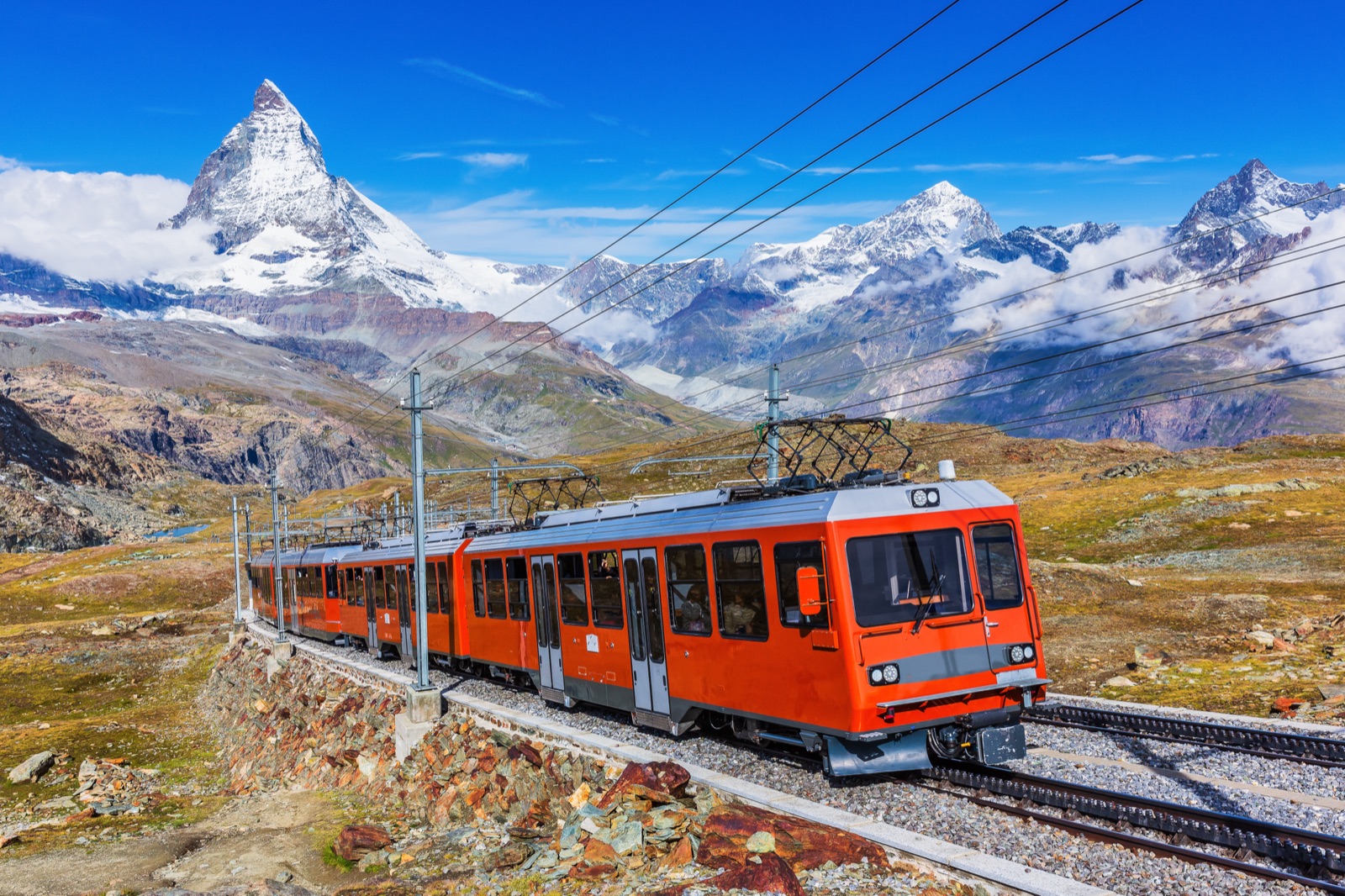
Ride the Gornergrat railway
The cogwheel railway, opened in 1898, climbs from 1,604 m in the centre of Zermatt to 3,089 m, with the Matterhorn in view for much of the way. At the top, the viewing platform looks out over 29 peaks over 4,000 m. Return fares from Zermatt were CHF 132 in the May 2025 to October 2026 period, with 50% off for holders of the half-fare card, GA or Swiss Travel Pass. Trains run every 24 minutes in summer, the first leaving Zermatt at 07:00.
Go to Matterhorn Glacier Paradise
The cable car from the southern end of the village climbs to the highest mountain station in Europe, at 3,883 m. Its platform looks out over 38 four-thousand-metre peaks and 14 glaciers in three countries. Zermatt Tourism calls it Europe’s highest excursion destination, open all year. Children under three may not ride beyond Trockener Steg, for health reasons.
Walk into the Glacier Palace
At the top of the same cable car, the Glacier Palace lies 15 m below the glacier surface. It is open all year, takes 30 to 45 minutes to visit and is cold, so bring warm clothes. The summit also has the Cinema Lounge and the highest mountain restaurant in Europe.
Cross into Italy by cable car
The Matterhorn Alpine Crossing links Zermatt and Breuil-Cervinia over the glaciers in 90 minutes, crossing the border at nearly 3,500 metres. In September 2026 Zermatt Bergbahnen listed it from CHF 147.50; a single ticket is valid for 2 days and a return for 10 days, so you can stop on the way. On Testa Grigia you can stand with one foot in Switzerland and the other in Italy. Our journal article on Cervinia covers the route.
See the Matterhorn from the Rothorn
The funicular to Sunnegga, then the lifts via Blauherd, take you to the Rothorn, whose summit station Zermatt Bergbahnen gives as 3,103 m on its peak page. Locals call this the Matterhorn at its most photogenic. Lower down at 2,350 m, the Peak Collection is an outdoor exhibition of 18 sculptures with the four-thousanders as a backdrop.
For a head-to-head comparison of the two main viewpoints, read Gornergrat or Glacier Paradise.
Lakes and walks
Photograph the Riffelsee reflection
From Rotenboden station on the Gornergrat railway it is about 10 minutes, gently downhill, to the Riffelsee at 2,757 m, where the Matterhorn is reflected in the water on a still day. The full Riffelseeweg on to Riffelberg is about 1 h and 2.9 km, and children from 4 years can manage it.
Walk the 5-lake route
From Blauherd (2,571 m) to Sunnegga (2,288 m), the 5-lake route passes the Stellisee, Grindjisee, Grünsee, Moosjisee and Leisee in about 3 h 30 min and 11.3 km. Three of the lakes reflect the Matterhorn. If you only want one, ride to Blauherd and walk to the Stellisee (2,537 m), the most famous reflection of all.
Swim at the Leisee
The Leisee (2,232 m), just below Sunnegga, is Zermatt’s beach: a playground, barbecue areas, picnic spots and a raft, with a glorious view of the Matterhorn. There is swimming at the Leisee and at the Grünsee.
Hike to the Hörnli hut
The Hörnliweg climbs from Schwarzsee (2,583 m) to the Hörnli hut (3,260 m), at the foot of the Matterhorn’s climbing ridge, in about 2 h 15 min. It is graded demanding (T4), with exposed sections and metal staircases, and it is for hikers with a sure foot and a good head for heights. From the hut terrace you can watch climbers on the ridge with binoculars. The hut is open only from the end of June until the end of September, serves lunch from 11:00 to 15:00 without reservations, and its tap water is not drinkable, so carry your own.
Walk the Matterhorn Glacier Trail
From Trockener Steg (2,939 m) down to Schwarzsee (2,583 m), the Glacier Trail crosses land the Furgg and Theodul glaciers covered not long ago: about 2 h and 6.6 km, with 23 stations explaining the retreat of the ice. All the hikes, with grades and tickets, are in our Matterhorn hikes guide.
Walk to Zmutt for lunch
No lift needed: the Zmutt path leaves from Zermatt station and climbs gently through forest and meadows to the hamlet of Zmutt (1,937 m) in about 1 h 35 min. It is graded easy, ends at old houses and narrow alleys with good places to eat, and has a magnificent view of the Matterhorn’s north face.
Eat on a terrace in Findeln
The hamlet of Findeln, below Sunnegga, is famous for mountain restaurants with terraces facing the Matterhorn. Walk there on the Findlerweg from Sunnegga, which passes the Leisee and then descends through open forest to Winkelmatten in about 1 h 10 min.
In the village
Visit the Matterhorn Museum – Zermatlantis
The underground museum tells the story of the village and of the first ascent. Its most famous object is the broken rope from 1865, when four of the seven climbers died on the descent. You will also meet “Theo”, a 16th-century mercenary who failed to cross the Theodul Pass, and see how Zermatt’s people lived in the 19th century, in original houses and interiors.
Wander the old village
The Hinterdorf, the old part of Zermatt, has around 30 traditional Walser buildings next to the Grand Hotel Zermatterhof: barns, stores, stables and houses built between the 16th and 18th centuries, some up to 500 years old. Many stand on flat stone slabs balanced on stilts to keep out mice. They are built of resinous larch, which weathers almost black over the years.
Follow the village walk
Zermatt Tourism’s village walk is 1.8 km and takes about 1 h 30 min, or up to half a day if you stop. It links the best of the village:
- The church bridge and church square, from where the Matterhorn rises alone to the south-west, and the classic village photo of old wooden houses with the mountain behind.
- The mountaineers’ cemetery, with memorial stones to Peter and Peter Taugwalder and to Michel-Auguste Croz of the first ascent party.
- The Hotel Monte Rosa, Zermatt’s first hotel, which carries a plaque for the first ascent; Edward’s Bar inside keeps beams and walls from the village’s first inn of 1839.
- The Ulrich Inderbinen fountain, named after the guide (1900-2004) who led guests up the Matterhorn until he was 90 and climbed it over 370 times. The ice-cold water is drinkable.
- The Scheibenwald path, a quiet Way of the Cross with small shrines, old granaries on stilts and benches with a view of the Matterhorn.
Watch the goat parade
In July and August a herd of black-necked goats walks along the Bahnhofstrasse around 9am and 5pm. It is free, brief and much photographed.
Walk the Gorner gorge
Wooden walkways lead between towering cliffs above the rushing Gornervispa, through greenish serpentinite about 220 million years old. The gorge is a 15-minute walk from the southern end of the village and the traverse takes 20 minutes. It is open from the end of May to the middle of October, daily 9:15 am to 5:45 pm, and entry is CHF 5.50 for adults, CHF 3 for children of 6 to 15 and free under 6. It is closed from 18 October 2026 to 31 May 2027. Just above it, the Furi suspension bridge is 100 m long and 90 m above the ground.
Watch the sunrise from the village
You do not have to leave the village to see the best light. Early in the morning the first sunbeams strike the summit of the Matterhorn and slowly descend its east face, which you can watch from the church bridge. In the evening, the same view shows the last glow on the peak. For the best season and time of day, and the chances of cloud, read When to See the Matterhorn.
Further afield and all year
Cross the longest suspension bridge in the Alps
Down the valley near Randa, the Charles Kuonen bridge is 494 m long and up to 85 m above the ravine. Crossing it is free and takes just under 10 minutes. The circular walk from Randa station takes about 4 h, and the bridge is closed in winter.
Ski, in winter or summer
Zermatt’s ski area, sold as the Matterhorn Ski Paradise, has 360 km of pistes and 52 lifts across 2 countries, and the glacier means skiing and snowboarding 365 days a year. The 2026/27 winter season runs from 1 November 2026 to 3 May 2027. Passes, season dates and the link to Italy are in our skiing guide.
On a rainy day
Zermatt Tourism says the destination has 300 days of sunshine a year, but the Matterhorn is often in cloud, and a wet day needs a plan. Its own bad-weather list includes:
- The Matterhorn Museum – Zermatlantis.
- ZOOOM the Matterhorn, on the Gornergrat, where you float over the landscape in a virtual hang-glider and look through a digital telescope.
- The mountaineers’ cemetery and the old village, which are atmospheric in any weather.
- The Randa rockslide, down the valley, and its exhibition.
- Indoor climbing, escape games and the cinema.
Mountain weather can change within minutes, so keep checking. Our Zermatt weather page has the forecast for the village and the viewpoints.
Getting around between sights
Zermatt is car-free, so everything in the village is on foot or by small electric vehicle. You get around walking, by e-taxi, by horse-drawn carriage, by bicycle or on the free e-bus, which runs two routes: the Ski-Bus and the Winkelmatten line. The Gornergrat railway’s valley station is directly opposite the main railway station, the Sunnegga funicular is close to the centre, and the Matterhorn Express gondola to Furi, Schwarzsee, Trockener Steg and Glacier Paradise leaves from the southern end of the village, near the path to the Gorner gorge. Allow time to walk between them; the village is long and narrow.
If you arrive by car, you leave it in Täsch, where shuttle trains run every 20 minutes and reach the centre of Zermatt in 12 minutes. Our guide How to Get to Zermatt has the train and road details.
Practical tips for a Zermatt day
- Go early. The Matterhorn is most often clear in the morning, and the first lifts are the quietest.
- Buy lift tickets online. Gornergrat tickets can be booked at any time and scanned as a QR code at the gate, avoiding the queue at the counter. Priority boarding, with a separate waiting area, costs CHF 7 extra.
- Look at the webcams before you buy. If the top is in cloud, swap the order of your plans and do the village first.
- Dress for two climates. The village can be warm while the summit stations are cold, especially in the wind.
- Take the altitude seriously. Walk slowly at 3,000 m and above, drink plenty of water, and come down if you feel unwell.
- Know the refund rule. If an experience booked with Zermatt Bergbahnen is cancelled because of bad weather, the amount paid is credited back automatically.
- Check the lift timetables. Some lifts close for maintenance between seasons, and in 2026 the Gornergrat railway was out of service from 2 to 14 November for construction work.
How to fit it in
With one day: take an early Gornergrat train, walk from Rotenboden past the Riffelsee to Riffelberg, ride down, and spend the afternoon in the old village and the Matterhorn Museum.
With two days: add Matterhorn Glacier Paradise and the Glacier Palace on the clearer morning, and the Glacier Trail or the Gorner gorge in the afternoon.
With three days: add Sunnegga, the 5-lake route and lunch in Findeln, or cross to Italy on the Alpine Crossing. Keep one morning in hand for whichever viewpoint was cloudy.
In winter: most of the summer walks are under snow, but the Gornergrat, Glacier Paradise, the Glacier Palace, the museum and the old village all work in winter, and non-skiers can walk the prepared winter paths, try snowshoeing with a guide, or go sledging and ice skating.
If you plan to use several lifts, the Peak Pass, from CHF 190 in November 2026, gives unlimited travel as timetabled to Matterhorn Glacier Paradise, Riffelberg, the Rothorn and the Gornergrat, with the Glacier Palace, ZOOOM the Matterhorn, the local bus and the train between Randa, Täsch and Zermatt included. Guided options, from a Gornergrat ticket to a small-group half day at Glacier Paradise, are on our tours page.
Frequently asked questions
What is there to do in Zermatt besides the Matterhorn?
Plenty: the Matterhorn Museum, the old Hinterdorf, the Gorner gorge, the goat parade in summer, walks to Zmutt and Findeln, the lakes above Sunnegga, the suspension bridges at Furi and Randa, skiing all year and the cable car into Italy.
What is the best thing to do in Zermatt?
For most visitors, an early ride on the Gornergrat railway, then the walk past the Riffelsee, where the Matterhorn is reflected in the water. On a clear day, Matterhorn Glacier Paradise is the highest alternative.
What can you do in Zermatt for free?
Walk the old village and the village walk, watch the goat parade in July and August, visit the mountaineers’ cemetery, drink from the Inderbinen fountain, walk the Zmutt path, and cross the Charles Kuonen bridge near Randa.
What is there to do in Zermatt when it rains?
Visit the Matterhorn Museum – Zermatlantis, try ZOOOM the Matterhorn on the Gornergrat, go indoor climbing or to the cinema, or visit the Randa rockslide exhibition.
Is one day enough in Zermatt?
One day is enough for the Gornergrat, the Riffelsee and the village, but the Matterhorn is often in cloud, so two or three days give you a far better chance of seeing it clear.